Custom MCP servers
Expose useful product capabilities through a clear server interface, designed around the workflows your customers need.

OUR EXPERTISE
Connect AI assistants to your product through purpose-built Model Context Protocol servers, tools and permission-aware workflows.
BUILT AROUND YOUR PRIORITIES
Make useful workflows available where your customers already work. A purpose-built MCP integration can let a compatible assistant retrieve account information, find resources or request an allowed action through your existing application.
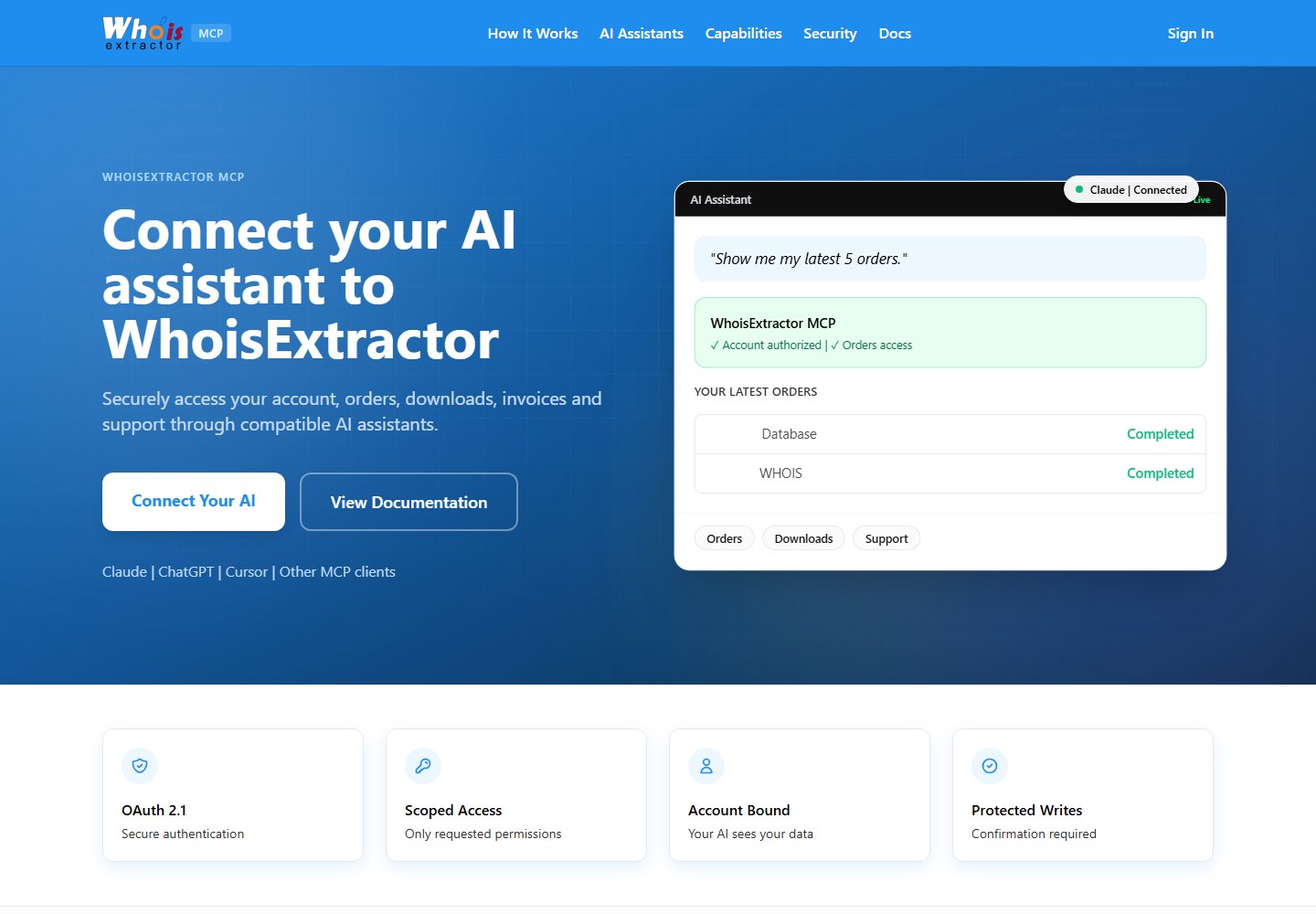
For WhoisExtractor MCP, the public integration presents account, order, download, invoice and support workflows through compatible AI clients. It is a concrete example of taking product capabilities beyond a traditional dashboard.
Explore the WhoisExtractor MCP project.
We design tool contracts, permission checks and error handling together. The application remains responsible for authorization; an assistant’s request is never a substitute for access control. Tool output is treated as data, and sensitive changes need an explicit, agreed workflow.
Bring your product API and a short list of user tasks. We will help identify the clients to test, the implementation scope and the work needed to maintain it.
A PRACTICAL SCOPE
We shape the final scope around your priorities, constraints and existing systems.
Expose useful product capabilities through a clear server interface, designed around the workflows your customers need.
Define inputs, outputs and actionable errors so compatible assistants can discover and use your product capabilities.
Connect authentication and authorization to the actual application. Check account access on the server for every protected operation.
Wrap suitable APIs and business logic rather than duplicate your application. Preserve validation and business rules.
Separate reads from changes, expose consequences clearly, and design confirmation and audit handling for sensitive actions.
Validate the agreed clients, document setup and scopes, and test timeouts, revoked access and unexpected inputs.
FROM DISCOVERY TO DELIVERY
Scope and timing are agreed after discovery, with reviews throughout delivery.
Map user requests to real application capabilities. Identify the minimum useful read and write operations.
Agree identity, scopes, tenant isolation, data handling and confirmation requirements before implementing tool calls.
Implement the MCP server and API adapters, then test the agreed transport and compatible client setup.
Exercise authorization and failure paths, document setup and operations, and prepare a maintainable release.
BEFORE WE BUILD
The Model Context Protocol gives compatible AI applications a standard way to connect to external tools and context. An MCP server exposes selected capabilities of your product; it does not replace your application or database.
A website chatbot is a conversation interface on your site. An MCP integration lets compatible AI applications work with your product’s tools and context. A project may use either approach or both.
Yes, where the product exposes suitable APIs or business logic. We first review authentication, permissions, rate limits and the operations you want assistants to perform.
Client capabilities and connection requirements differ. We agree a target client list, test those integrations and document any limitations instead of promising universal compatibility.
Share your API documentation and three or four tasks users should be able to request. We will map the tool contracts, permissions and implementation scope with you.
LET’S BUILD SOMETHING USEFUL
Tell us what you want to achieve with mcp development. We’ll help clarify the scope and a practical way forward.